Service
Room treatment and soundproofing so speech stays clear — and stays in the room.
Measurement-led acoustics for auditoriums, classrooms, boardrooms, and studios. We set reverberation and noise targets, install absorption and diffusion, and soundproof partitions, doors, and plant so the room supports the programme before any loudspeaker is tuned.
A loudspeaker cannot shorten the decay of a marble sabhagruha, and a fabric panel on the rear wall cannot stop a board meeting from being heard in the corridor. Those are different problems, and Maharashtra buildings usually have both. Civic halls in Camp, school auditoriums in Kondhwa and Agarkar Road, and worship rooms in Dehu Road and Dandekar are finished in plaster, stone, glass, and timber — surfaces that keep sound alive long after the speaker has stopped. At the same time, confidential reviews, music rooms, and plant areas sit next to spaces that must stay quiet. Sai Enterprises AV Solutions treats Acoustic Service & Sound Proofing as its own scope: measure the room, set a reverberation and noise target for the programme, install absorption and diffusion where the decay is too long, and isolate partitions, doors, glazing, and machinery where sound must not travel. National Building Code of India 2016, Part 8, Section 4 is the reference we design against, with on-site checks to ISO 3382 for reverberation and IEC 60268-16 for speech transmission index when a sound system is part of the same job. DSP EQ on a Biamp or Bose processor can tame a harsh loudspeaker. It cannot replace missing absorption, and it cannot seal a door.
Tell us about your space and we'll recommend the right approach.
Get a QuoteWhatsApp +91 72188 34918Assembly halls such as YASHADA's auditorium, Pune Zilla Parishad's Yashwantrao Chavan Sabhagruha, and school stages at Vidyashil Public School and Shri Mahavir Jain Vidyalaya mix speech, recorded music, and occasional live performance in hard rooms. Parallel side walls flutter, rear walls slap the stage, and a high plaster ceiling holds mid-band energy. We measure unoccupied reverberation before specifying anything, then place absorption on the rear and upper side walls, keep a reflective zone near the stage for unamplified voice, and add ceiling clouds only where the decay is still long. Multipurpose halls are tuned for speech first — typically a mid-band reverberation time around 1.0 to 1.4 seconds — with enough diffusion that music does not sound boxed in. Treatment is coordinated with stage craft when curtains, seating, and rigging are in the same build, and with the loudspeaker design so coverage is not fighting the room.
A 40-seat classroom with bare RCC and a noisy fan or split AC fails speech long before the display is the problem. Teachers at campuses such as DY Patil University Tathawade and Sanskruti International School in Wakad need a short, even decay and a quiet background so a normal voice reaches the last row. We target a mid-band reverberation time under about 0.8 seconds for occupied teaching rooms, check background noise against a noise-criterion curve, and treat the ceiling and the wall opposite the teaching wall first — the highest-leverage surfaces in a rectangular Indian classroom. The same survey covers seminar rooms that combine a lecturer, ceiling microphones, and lecture capture, where a long tail makes recordings muddy even when the live level seems acceptable.
Soundproofing is the brief when the conversation itself is the asset. Executive rooms on SB Road and departmental review rooms in government offices need partitions, doors, and glazing that hold speech inside, not another layer of foam on the wall. We specify the weighted sound reduction (Rw, ISO 717-1) for the partition as a system: stud or masonry mass, a damped cavity, and seals. The usual failures are the door leaf without a drop seal, a gap under the frame, a shared ceiling plenum, and a return-air path that bypasses the wall entirely. Absorption inside the room still matters — a lively boardroom is tiring and confuses conferencing microphones — but it is specified separately from the isolation rating. A thick door with a 15 mm gap underneath is not a soundproof door.
Houses of worship such as the Golden Temple at Dehu Road and Ramakrishna Math in Dandekar need speech for discourse and a longer, more even decay for bhajan and instrumental programmes. We do not deaden a music room down to a classroom. Bass is treated with membrane or Helmholtz absorbers where porous panels, which work from the mid band up, leave low-frequency bloom. Where a practice room, control room, or generator and AHU plant sits against an occupied hall, the scope shifts to isolation: vibration breaks under equipment, lined ducts or silencers on the air path, and sealed penetrations. Structure-borne noise from a rooftop unit will come through a treated wall that looks perfect on a drawing.
Every acoustic engagement starts with a site survey in Pune or elsewhere in Maharashtra. We record dimensions, finishes, seating, and the noise sources that are already there — split ACs, ceiling fans, open windows onto a road, an AHU above the ceiling. Impulse-response measurements give reverberation time by octave before any product is named. For soundproofing we inspect the partition as it will actually be built: door undercut, glazing thickness, plenum barriers, and service penetrations. The report states the target, the shortfall, and a bill of quantities split into treatment and isolation so a client can phase the work.
Installation follows the drawing. Panels, clouds, and bass absorbers are fixed to marked positions, not distributed by eye on the day. Doors get perimeter gaskets and automatic drop seals; glazing details are checked before the frame is closed. Where masonry, a floating floor, or a new HVAC silencer is required, we issue the detail to the civil or MEP contractor and inspect it before boards go on. After installation we measure again. The handover pack includes the before-and-after reverberation curves, a note of residual noise, and, when we are also commissioning the sound system, the speech-intelligibility result. Operators receive a short explanation of what must not be removed during later painting or renovation — absorption hidden behind a new gypsum skin is a common way a treated hall goes lively again.
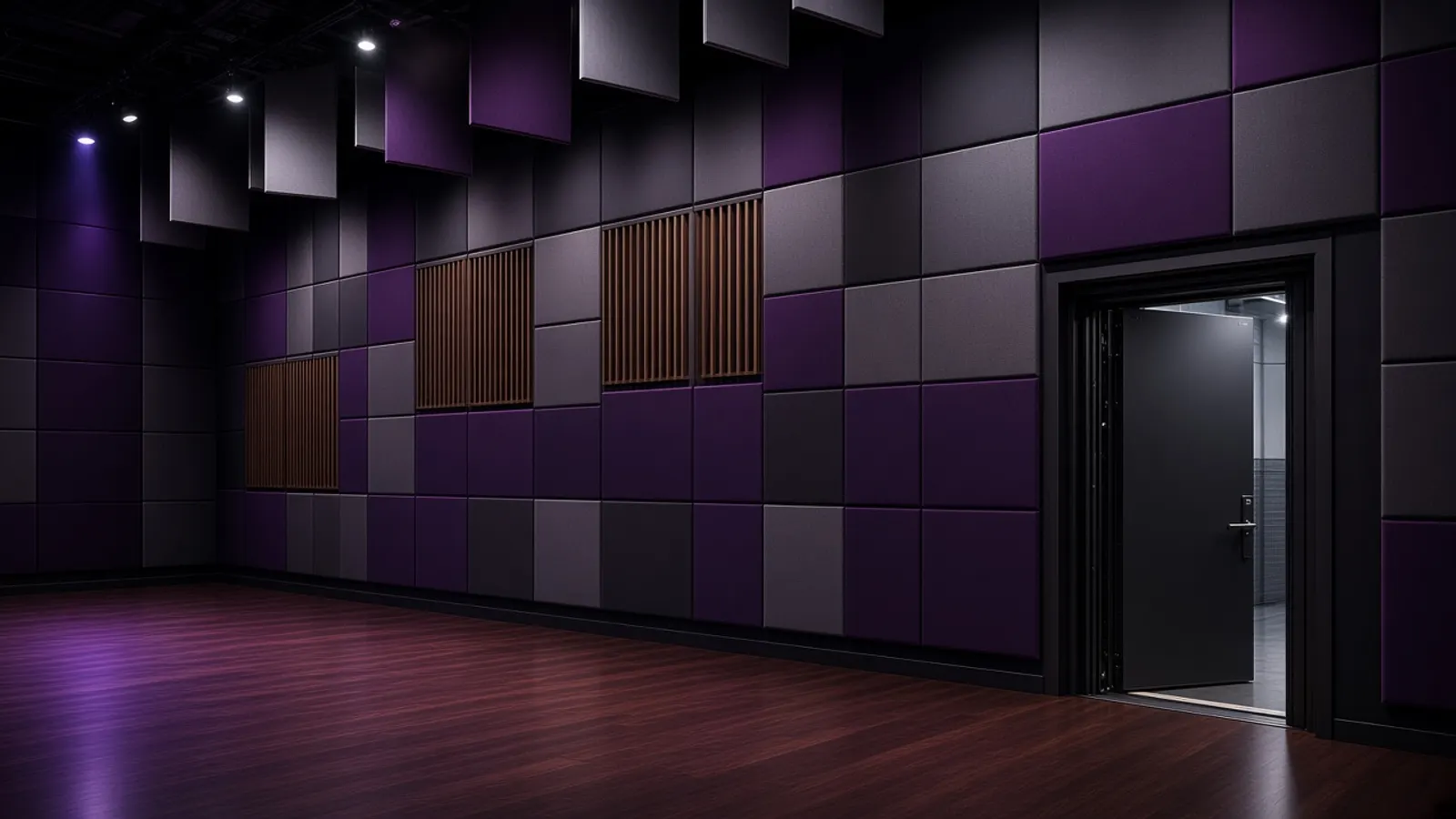
Treatment is specified by acoustic performance, not by a single catalogue. Fabric-wrapped mineral-wool panels and perforated timber with an absorber backing cover mid and high frequencies. Ceiling tiles and suspended clouds handle the large area above the audience. Tuned membrane and Helmholtz absorbers, and corner bass traps, are used where the octave-band data shows a low-frequency problem that porous material will not touch. Diffusers are added in larger halls so the room does not become dead once the slap echo is gone.
Soundproofing uses acoustic doorsets with drop seals, laminated or double glazing with a real air gap, cavity barriers above partitions, duct silencers, and vibration isolators under plant. We do not sell 'acoustic foam' as a soundproofing product: foam on a wall changes the decay inside the room and does almost nothing to the sound that leaves it. Products are commercial-grade, with published absorption or sound-reduction data, and are installed so the air gap and backing in the test certificate match the site condition. The acoustic design sits beside our JBL, Bose, Biamp, and TOA audio work — the room is finished first, then the loudspeakers are aimed and equalised into a space that can actually hold speech.
ZP Yashwantrao Chavan Sabhagruha (New), Pune
Camp, Pune · Government
Speech-first sound reinforcement, chairman-delegate conferencing, and presentation displays for Pune Zilla Parishad's Yashwantrao Chavan Sabhagruha — built for council sessions, gram sabha hearings, and state-level civic ceremonies.
Vidyashil Public School Auditorium
Kondhwa, Pune · Education
Performance-ready sound reinforcement with QSC loudspeakers and Yamaha processing for the school auditorium — supporting assemblies, annual days, and student performances on the Yewalewadi campus.
YASHADA Auditorium, Pune
Ganeshkhind, Pune · Government
Performance-grade auditorium AV for Maharashtra's apex government training institute — reinforcement, presentation, and conferencing for 250–300-seat programmes at the Management Development Centre.
The Golden Temple, Dehu Road
Dehu Road, Pune · Religious
Speech-clear Gurdwara sound reinforcement for kirtan, ardas, and daily programmes — Quest Audio loudspeakers and Yamaha mixing with discreet installation that respects the sanctum's golden Palki Sahib interior.